
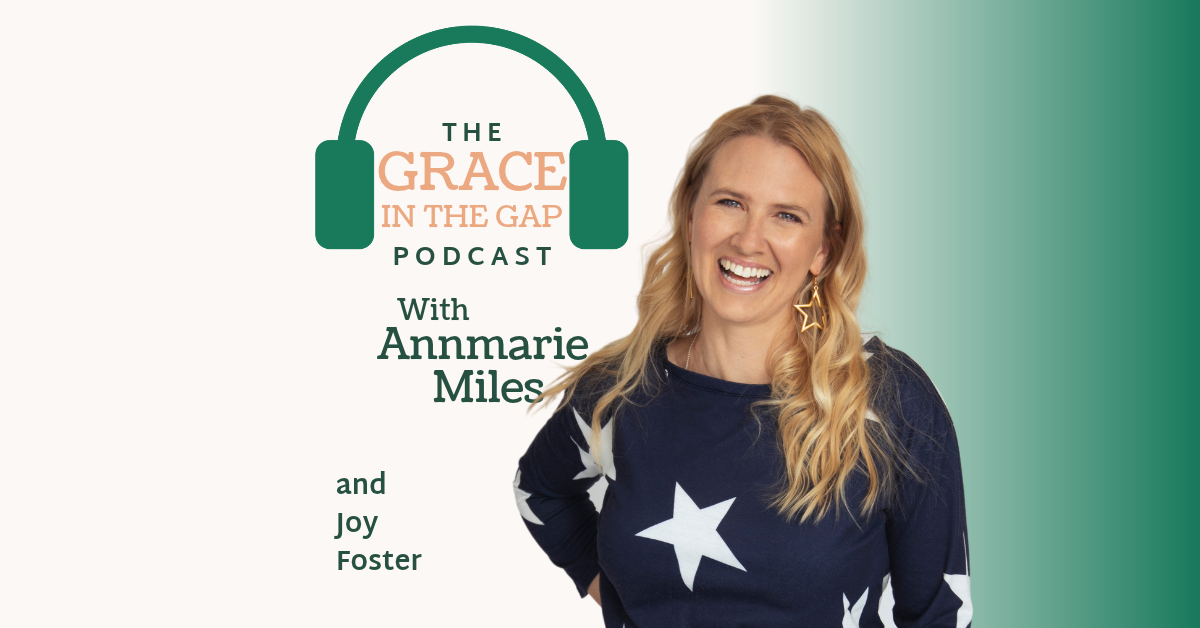
What can an adult ADHD diagnosis teach us about our past? My latest guest on the Grace in the Gap podcast, Joy Foster, has been discovering just how much greater self-awareness can change the way we understand our experiences.
And she has some extraordinary stories to tell.
Imagine spending four years training for an Ironman, completing the swim and the cycling stage, getting into your running shoes and discovering that you're 53 seconds too late to continue.
FIFTY-THREE SECONDS!
I think I'd still be sitting on the ground crying.
Although Joy didn't finish the Ironman, something extraordinary had already happened during the swimming stage.
Years earlier, Joy had competed as a member of the US national archery team. She'd worked incredibly hard towards her Olympic dream but eventually stepped away from competitive archery as her life changed.
For years, she carried a sense of unfinished business. She felt she'd failed.
Then, during Ironman Wales, surrounded by thousands of cheering spectators, she experienced something of what she'd always imagined competing at the Olympics would feel like.
Something began to heal.
Although neither sporting ambition turned out as she'd hoped, that moment in the water helped her make peace with a dream she'd struggled to let go of.
It made me wonder how many of us focus so much on the finishing line that we miss what's happening to us along the way.
What happens when you receive an adult ADHD diagnosis?
Joy received her ADHD diagnosis at the age of 43.
As she's learnt more about how her brain works, she's begun to recognise patterns in her life that previously hadn't made sense to her.
She now has a better understanding of her need for stimulation, her love of ambitious goals and some of the challenges she's faced in business.
For Joy, an adult ADHD diagnosis has given her an opportunity to understand herself better and look differently at some of her past decisions.
Of course, this new understanding hasn't automatically resolved her difficulties. She's still working through some of them and seeking specialist support.
However, she now knows things about herself that she didn't know when she made those earlier decisions.
And that matters.
Can we take responsibility without blaming ourselves?
I particularly appreciated Joy's willingness to take responsibility for the things she wants to change.
She said:
“It explains it, but it doesn't excuse it.”
Joy wants to use what she's learnt about herself to make different decisions in the future.
I think there's an important balance to find here.
We can acknowledge that some of our decisions haven't served us particularly well. Perhaps we recognise patterns of behaviour that need to change. Sometimes we even have to face the difficult consequences of our choices.
And we can do all of that without being horrible to ourselves.
I've spent a considerable amount of my own life kicking myself in the shins (metaphorically and literally).
I've given myself a hard time for not being further along in my journey, for still struggling with things I thought I'd have sorted by now, and for falling short of my goals.
All that criticism hasn't helped me make the changes I want to make.
Understanding myself better has been far more helpful.
Why looking back can help us move forward
During our conversation, Joy mentioned a book called The Gap and the Gain.
One of the ideas she's taken from the book is the importance of measuring our progress backwards.
When we constantly compare ourselves to the person we hope to become, we tend to focus on everything we haven't achieved yet.
Looking back allows us to recognise how far we've already come.
Joy has achieved some extraordinary things in her life. She's competed internationally as an archer, built a business and helped women develop skills, find employment and pursue new ambitions.
Yet, like so many of us, she sometimes finds it difficult to appreciate those achievements while facing the next challenge.
Perhaps we could all spend a little more time recognising what we've already learnt, achieved and overcome.
We don't have to abandon our ambitions to appreciate our progress.
A simple daily exercise for recognising progress
Joy shared a daily practice that helps her recognise the good in her life.
She calls it the five-three-three approach:
- Five things you're grateful for today.
- Three wins from today.
- Three wins you're anticipating tomorrow.
Your wins don't have to be particularly impressive.
You might have made a phone call you'd been putting off. Maybe you asked for help, went for a walk or managed to have a difficult conversation.
Perhaps you noticed a familiar pattern of behaviour and responded differently, even if only for a moment.
Those things count.
When we start looking for signs of progress, we might be surprised by how many we find.
Learning to be kinder to yourself
Towards the end of the interview, I asked Joy what encouragement she would offer someone struggling in the gap between where they are and where they want to be.
She talked about the importance of the first thing we say to ourselves when we look in the mirror in the morning.
Joy has developed a habit of looking herself in the eye, smiling and saying:
“I love you. I'm so proud of you. You're doing great. Keep going.”
She admitted that it felt strange when she first started doing it.
I'd say many of us would feel the same, particularly if we've spent years greeting our reflection with a sigh, a grimace or a list of complaints.
How different might our mornings be if we started the day with a few words of encouragement?
We could all do with someone cheering us on. Why shouldn't that someone be us?
Finding God's grace in the middle of change
Joy and I are both Christians, and our faith plays an important part in how we understand our journeys.
During our conversation, I shared something that has become increasingly important to me.
I only want what God wants for me, but I want everything that he has for me.
I want to welcome the possibilities he has for my life and learn from the difficulties I encounter along the way.
I'm also learning that I don't need to wait until I've achieved my goals before I can enjoy my life, recognise God's goodness or extend some kindness to myself.
God's grace is available to me today, in the middle of the things I'm still working through.
Perhaps part of extending grace to myself means accepting that I'm still learning.
There are things I understand now that I didn't understand twenty years ago.
Although I can't go back and give my younger self that knowledge, I can use it today.
So can you.
Listen to my conversation with Joy Foster
In this episode of Grace in the Gap, Joy and I talk about adult ADHD diagnosis, ambition, business, disappointment, faith and learning to see failure differently.
Whether you're coming to understand your own ADHD, facing an unexpected change in your life or simply tired of being so hard on yourself, I hope you'll find something encouraging in our conversation.
And the next time you catch yourself looking in the mirror and preparing to give yourself a hard time, perhaps you could try Joy's approach.
Give yourself a smile, say something kind and offer yourself a little encouragement.
You're doing great. Keep going.
Connect with Joy on Instagram
Find out more about TechPixies